Some time ago I talked about Twitter. I wrote about how I love it for breaking news, lists and links. I've tweeted just over 500 times since my first post and I feel differently about Twitter now.
I still like the instantaneous newsroom. I was able to get first hand accounts of the earthquake and tsunami scare on the West Coast a few months back for at least an hour before any news networks had any coverage. During the NHL lockout hashtags, like #podiumwatch, kept me up to date, and laughing about, the progress of any upcoming press conferences.
I barely use lists anymore. I still have them, but I find that I barely go to them. I just scroll through my feed. Having reread my feelings about lists from a year ago, perhaps I'll work to get back in the habit.
I feel that I appreciate link sharing even more now. When I started I was mainly following education companies, sports organizations and personalities and friends. Through professional development, courses and twitter itself I have made connections with many individual educators. So many people have an open learning philosophy and share links to things they find useful. I have found them very useful and have been working to share my fair share in return.
Even better than the links are the relationships. Many people feel that the internet isn't real and doesn't count some how, but it's just a new way to get to know people. The glimpses I see of the attitudes, philosophy and professionalism of experienced educators, 140 characters at a time, are a great example and have helped me grow as an educator. I can thank someone for sharing a link or skyping with my class and start a new relationship. I've been able to encourage colleagues to start Tweeting and see them find new ways to improve their teaching. Twitter started as a place I found things - news, scores, resources, but is now a place where I am able to share and learn with people.
I look forward to staying in touch with everyone in the Internet for Educators class throughout our careers with our class hashtag and plan to continue to meet more people and share my learning, successes, struggles and stuff!
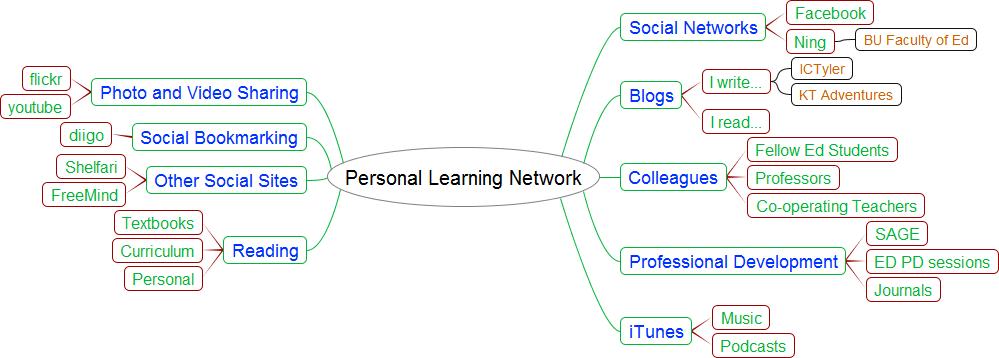
I have spent a lot of time this week pondering connecting. It's been the overarching theme of the first weeks of my Internet for Educators course at BU. I joined #ETMOOC and the first topic was connected learning. I've heard speakers talk about it. I've had assignments to research it and visualize it.
I think connecting with one another is so important. Through the internet we have access to more information and more people than ever before. However, making good use of this depends the connections we make. There is no possible way I could scour the entire internet to find the best physics resources, but if I connect and share with communities of physics teachers, physicists and like minded individuals we cover more of what's out there and all get access to more and better resources. This is just one example of the benefits of being a connected learner.
Here is a map I made of the connections I've forged so far.
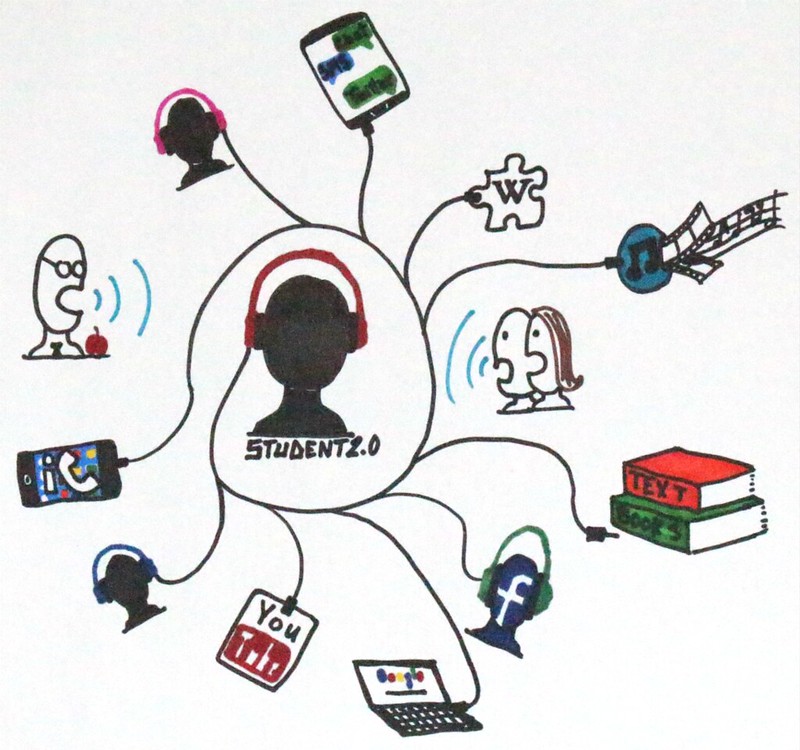
It's also important to remember that everyone has a personal learning network, even my students. This is what I imagine what my future students' learning networks will look like:
I've found thinking about the connections my students use to learn on their own a very productive exercise. If I can align how students learn in my class with how they learn on their own I hope to connect the classroom to their lives, to change school learning from a chore to a natural process.
This week Dean Shareski { @shareski, Ideas and Thoughts, Community Manager for Discovery Education Canada, UofR Education Professor } talked to our class via skype.
He shared a lot of good ideas, like:
Teaching isn't rocket science, it's more complex and demanding!
We can never find THE solution/method for being the perfect teacher.
Describe not prescribe. Do over telling.
We are in the middle of a media explosion, akin to the printing press - we need to be the ones to figure out etiquette, appropriate use and teach it.
Dean had 3 Lessons for us as teachers entering a new and changing educational landscape.
1. Think Differently About Literacy
Normal distribution of Language Arts in class.
Literacy is more than reading and writing now. There are so many ways to communicate with others and so many ways messages come to us, that we need to teach students to how to be informed (read/listen/view)ers and effective (write/speak/represent)ers.
Storytelling is an important part of this. We have so many facts available to us that sharing lists of facts means nothing, we need to deliver them in context and with emotional impact.
This video is an excellent example of this. It shares a lot of facts, but is memorable and engaging because of the story. I've only watched it once, when Dean shared it, but I don't think I'll ever forget the penguin thief, especially if at some point in the future I'm building a nest of "hand"-picked rocks in the Antarctic to try and secure a mate.
Dean addressed the common complaint that internet content is primarily inane, profane or just plain bad. He thinks, and I agree, that creation is a continuum. Practice and training make us better. Most of us will start off terrible, but even making a lolcat is MAKING something!
The question is not "Why is this so bad?", but "How do I help my students get better?"
2. Teachers are everywhere!
The best thing about the internet isn't that content is digital, but that our learning culture is participatory. Most schools still think of the internet as a giant, unreliable and dangerous encyclopaedia. It definitely can be, but we need to teach kids to be resourceful and responsible. Expertise works differently now. Credentials aren't what they used to be. Excellent tutorial videos for nearly everything are available on Youtube and quite often they are made by children still in elementary school. Dean shared a personal story where through the magic of twitter he connected with a class of teenagers who taught him how to play the guitar through a series of videos they made for him. I learned how to replace a leaky radiator hose online. I didn't to see if the video was posted by a qualified mechanic and my car runs fine!
He also mentioned how teachers continually harp on Wikipedia. Telling students not to go to Wikipedia, but to go to people for primary resources. Wikipedia is made by people! It is a different kind of encyclopaedia, but it is an incredible work of shared knowledge. {aside: I love that there is a Wikipedia article on the reliability of Wikipedia.} Dean brought our attention to the commentary/discussion section of Wikipedia and the fact that it is completely transparent. We have no idea how what gets into a textbook, or other credible resource, gets in there. Should we have more trust for what an academic's peers reviewed or what our peers have created?
To sum it up, individual connection is still important, it just happens in new ways on the web and a person's small contributions can have a big impact.
3. You are What You Share.
The thought that really stuck with me is that great ideas seem obvious to the people who come up with them. We encounter ideas we think are amazing and beyond our abilities, but our ideas are the same to someone else. So, let's share! If everyone pools their unique ideas and talents together we accomplish more than the smartest individual can ever do alone.
This blog is one of the places I share. Here are a few more:
UPDATE: I forgot to mention that Dean is not as interested in curating information and resources as some, instead he curates people. He explained it like this:
For some reason I was a twitterphobe before this class. I guess I just saw it as a universal facebook status update or text message and I already do those things, so why add twitter to the mix.
When I first signed up in class I was not expecting much. I used it mainly as an alternative way to communicate with people I already knew. I stuck with it, though, and have learned a few things that convince me twitter is a very valuable resource to educator.
Some eye catching WFP tweets.
1. News - I followed the Winnipeg Free Press, and boy do they tweet a lot, but I found twitter delivers me news exactly how I like it: in 140 characters or less. Anything that catches my eye, I click the link and get the full article. It's the news I want, when I want it.
I also like how twitter has turned everyday people into reporters. With hashtags, searchability, and an open audience I can find live opinions on any topic I can imagine. Often breaking news is trending on twitter before traditional news media even has a response.
2. Lists - my experience with the sheer quantity of Winnipeg Free Press tweets led me to experiment with twitter lists. I created a news list and put WFP in it. I then unfollowed WFP. Their tweets are no longer filling up my timeline, and yet whenever I want to browse the news I head to my list and its all there.
3. Links - I think the true value in twitter is in links. Both the links we forge with others and the links shared in tweets. Since I joined for ICT class the first person I followed was miken_bu and I've found the links he's shared very informative. Then I checked out who he was following. Subsequently, I am following edutopia, artsintegration and mbteachers. They are a daily source of great resources, ideas and things that make me go hmm. My next step is to investigate who they follow and who follows them to forge even more links in an ever growing online community centred on education.
I plan to continue to use twitter to foster links with educators and share resources and ideas.
My twitter homepage.
I'm Tyler_JL if you want to follow me.